Why treat wool to make it machine-washable?
Wool is a natural raw material with many wonderful properties, but also requires special care. Wool fibres are the hair of sheep and have a roof-tile-like scale structure on their surface that is invisible to the naked eye. These scales are the reason why wool keeps you so wonderfully warm, as they trap air and thus create an insulating layer. A great advantage of merino wool, apart from its softness, is that it really only needs washing when it is genuinely soiled. This is because it has odour-neutralising properties, and it is usually perfectly sufficient to simply air it out in the fresh air after wearing it.
However, if untreated wool gets wet and is then exposed to heat and friction, the scales on the surface open up and become entangled with one another – the wool felts. Whilst this effect may be desirable in some cases, it is usually not the case with our hand-knitted treasures.
For this reason, wool yarns for hand knitting are often (with the exception of explicitly labelled felting yarns) treated with an anti-felting procedure that makes them machine-washable. It smooths the surface of the wool so that hardly any fibres stick out, which could become entangled with one another during rubbing and spinning in the machine.
So if you do need or want to wash your knitted items, you’ll find some important advice on this in our ‘Good to Know’ article. And with our tips, you don’t need to worry about stains either.
Of course, we could always hand-wash all our woolen clothes in cold water and take great care. But let’s be honest: washing them in the machine is simply practical and saves time and energy.
What is the most common method, and why didn’t we choose it?
Terms like ‘Superwash’ and ‘Total Easy Care’ sound great at first: you can simply pop your woolen garments in the washing machine without a second thought – so easy to look after. Unfortunately, however, the common Superwash treatment is not very sustainable.
This is because chlorine is used to remove the scales from the surface of the wool. The yarn is then coated with a layer of polymer. This makes it smooth and shiny, and prevents it from felting. However, the impact on wastewater is very high, and the wool also loses some of the properties we love so much about it, such as its ‘memory’ – meaning that lace, textured and cable patterns in particular lose their definition more quickly.
So how is Rosy Green Wool’s wool made machine-washable?
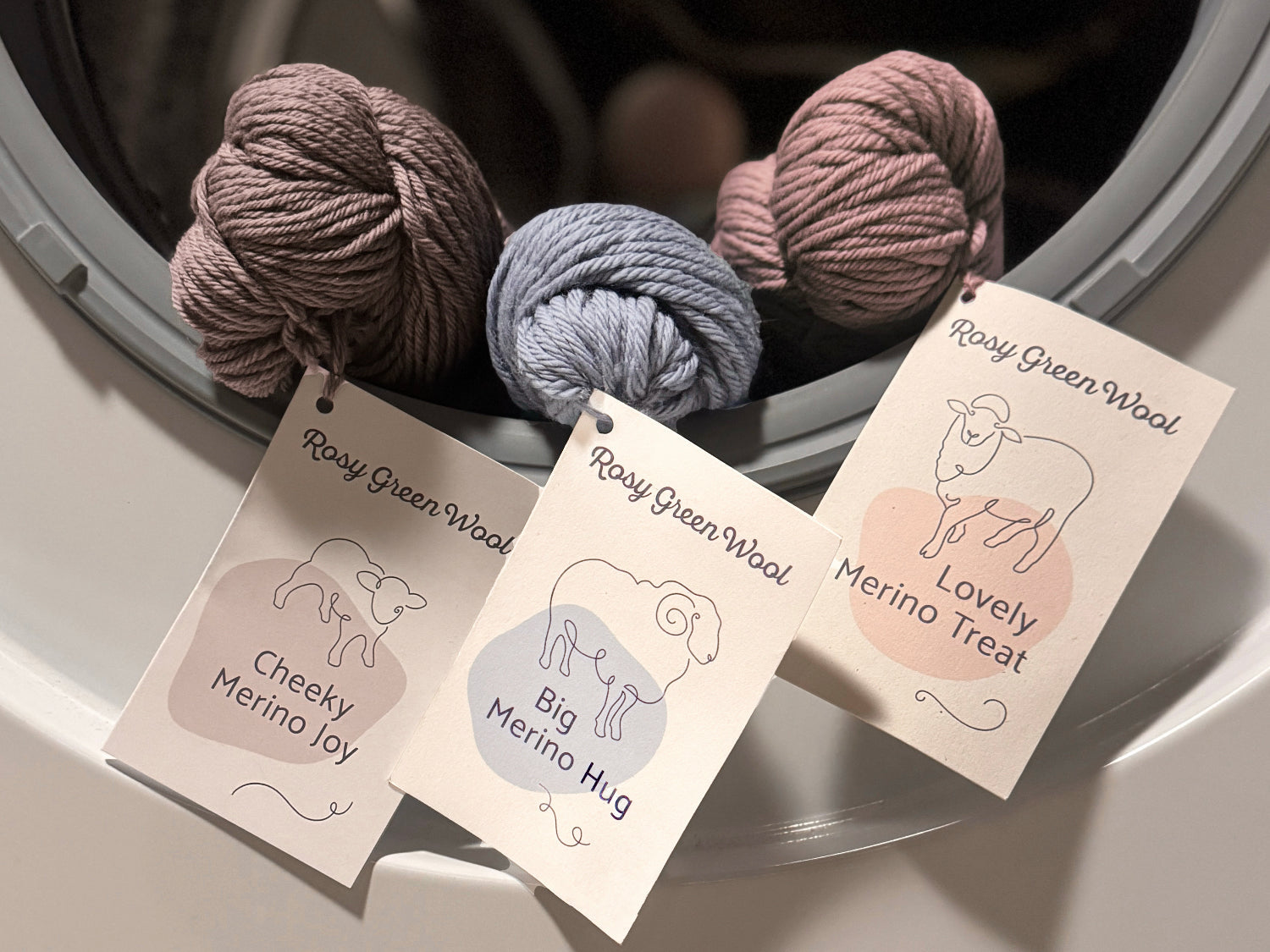
Our Cheeky Merino Joy, Lovely Merino Treat and Big Merino Hug are made machine-washable using a GOTS-certified process that is completely chlorine-free. Instead, the salt peroxymonosulphate is used, which significantly but very gently reduces the scales on the wool’s surface. With this chlorine-free process, we save many tons of water and help protect the environment.
The colour of the wool fibres remains natural with our treatment. Chlorine, on the other hand, makes the wool appear more yellowish. What’s more, the colour fastness is significantly higher after dyeing. So you can be sure that the shade you’ve chosen will last a long time and won’t look completely different after just a few washes.
This means you can be sure that our wool has the lowest possible environmental impact and that you’ll be able to enjoy its beautiful, colour-fast designs for a long time to come.